
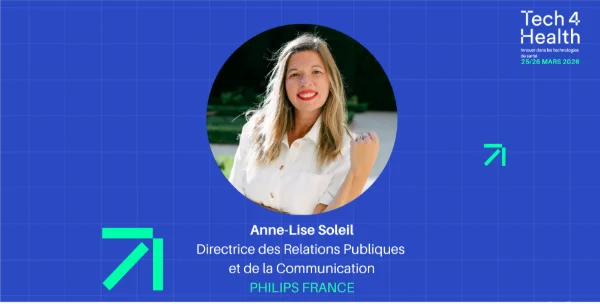
1. YOU HAVE AGREED TO JOIN THE SCIENTIFIC COMMITTEE OF TECH 4 HEALTH 2026. WHAT MOTIVATED YOU TO PARTICIPATE IN THIS COLLECTIVE ADVENTURE?
As a communications director, I am used to championing issues through the voice of my company. Being part of this corporate committee is a real opportunity for me to engage differently, through my own voice, to advance these health innovation topics further, in another way.
As a communications director, I am used to championing issues through the voice of my company. Being part of this corporate committee is a real opportunity for me to engage differently, through my own voice, to advance these health innovation topics further, in another way.
2. THE CENTRAL THEME OF THIS EDITION IS "CONNECT AND SECURE FOR BETTER CARE". WHAT DOES THIS THEME MEAN TO YOU IN YOUR AREA OF EXPERTISE?
I would say it means "closing the loop". The challenges facing the healthcare system are numerous. We often talk about technological innovation, about AI to enable system resilience. We talk less about the infrastructure, about health IT, which is, in a way, the foundation that allows innovation to land for better care. Innovation generates an incalculable amount of data, which needs to be connected and secured. It's about building the hospital of tomorrow, which is, in a way, merely the corollary of technological innovation. They are two sides of the same coin. One does not go without the other.
3. HOW DOES A GLOBAL INDUSTRIAL PLAYER LIKE PHILIPS INTEGRATE THE DUAL REQUIREMENT OF CONNECTION AND SECURITY INTO ITS SOLUTIONS?
Every day, large quantities of health data are generated by healthcare stakeholders (patient records, examinations, medical procedures, etc.). However, this data is often recorded and tracked on different solutions, making communication between various healthcare systems complex. Interoperability addresses this challenge, enabling fluid communication between different systems.
At Philips, we offer services related to device integration, vital signs monitoring, and clinical surveillance, connecting virtually all existing medical devices and electronic patient record (EPR) solutions in hospitals through a vendor-agnostic system.
The device is there to continuously capture clinical data from almost all medical devices, contextualize it, and share it with all points of care.
To meet the dual requirement of connection and security in these solutions, we integrate the principle of cybersecurity from R&D, right from the design phase. A dedicated working group intervenes upstream and downstream. This means it is there to establish safeguards that extend from product manufacturing to its installation. Then, because we are attentive to any potential vulnerability in real-time, we are able to intervene on these products based on feedback from the analysis of this dedicated group.
4. WHAT ROLE CAN COMMUNICATION PLAY IN BUILDING TRUST AROUND THESE INNOVATIONS?
Trust is a crucial issue. There are many misconceptions surrounding AI, and particularly around health data and its management. Who stores patient data, where, how? This is an eminently ethical subject. Similarly, healthcare institutions feel vulnerable to cyber risks and thus to data breaches. Therefore, the entire ecosystem, from the patient to the hospital director, needs to be reassured. And this is precisely where communication comes in.
Communication is there to bring the subject to the table and foster debate, on the one hand, by creating opportunities for public speaking. By working with specialized media, on the one hand, to raise awareness of the scope of the challenges and existing solutions. By working with traditional media, on the other hand, to allow these subjects to permeate the general public. This way, a wide spectrum can be reached, which is necessary to get on board. Because to generate buy-in, this trust must be enabled. It is necessary to popularize. It is necessary to defuse.
But the role of communication is also, and above all, to succeed in creating a virtuous circle of stakeholders who will engage with us, just as we do. We must act across disciplines, institutions, and borders. We must integrate users – caregivers and patients alike – from the design stage of digital tools. This is what will allow us to establish clear guidelines, robust scientific evidence, and regulations to structure this environment of trust, ensuring a serene and ethical adoption of these technologies.