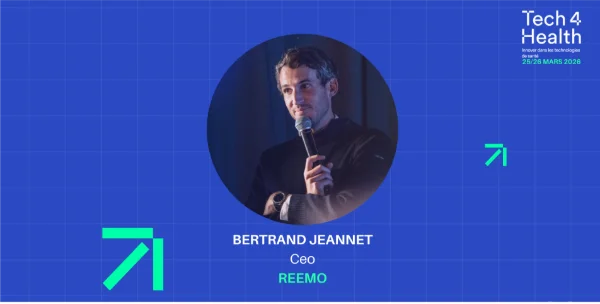
Given the growing cybersecurity challenges in the healthcare sector, Reemo is at the heart of the "Connect and Secure" theme. It is therefore important to be present at the 2026 edition of Tech4Health to support decision-makers in optimizing and securing their remote access. Our sovereign platform is now a real alternative to very expensive and flawed American solutions; it's time to change that.
As in industry twenty years ago, hospital equipment has become computerized and connected, often without real control over its operation or access rights. It is not uncommon for software to be installed with excessive administrator rights, opening critical doors to attackers. I have personally observed maintainers using a single password for all their clients, or credentials displayed on sticky notes.
1. WHAT DOES THE MAIN THEME OF CYBERCAMP SANTE 2026: "CONNECT AND SECURE" MEAN TO YOU?
In a healthcare facility, protecting the IT infrastructure directly translates to protecting patients.
Hospitals host extremely sensitive medical data and currently use care, diagnostic, and management tools that are fully connected to the network. Securing these systems therefore means protecting data, ensuring continuity of care, and preserving patient safety.
Healthcare facilities are among the most attacked targets in Europe.
Where are the most critical vulnerabilities in remote access today?
A hospital relies on a multitude of tools and external service providers.
Every piece of equipment or software, whether it's air conditioning systems, scanners, surgical devices, accounting software, or appointment scheduling, comes from a different vendor, who needs remote access for maintenance.
Unlike other sectors, hospitals do not develop their own hardware or software: they assemble external components, all connected to the network.
This proliferation of service providers and access points makes rights management extremely complex and is currently one of the main points of fragility in cybersecurity.
2. HOW IS SOVEREIGNTY STRATEGIC FOR THE PROTECTION OF HEALTH DATA?
Healthcare facilities today have very high-level European technological solutions, whether from medical equipment manufacturers or cybersecurity solution providers.
Regarding hardware, the issue is not solely strict sovereignty: as long as the equipment is properly secured and does not come from data-risk countries, the danger remains manageable, especially since budgetary constraints do not always allow for prioritizing sovereign solutions.
However, sovereignty in access management is essential. Remote access determines the exposure of patient and staff data. It is on this precise point that facilities must maintain total control.
3. HOW TO RECONCILE ACCESS SECURITY AND OPERATIONAL FLUIDITY IN HOSPITALS?
Hospital staff operate in an environment where time is not money, but a life.
Caregivers must focus on patients and emergencies, without being slowed down by heavy IT constraints.
One of the major challenges is the rapid and secure identification of personnel. Traditional passwords are both time-consuming and insufficient against today's highly professionalized hacking.
The answer lies in mechanisms like 2FA, and especially in simple and fast authentication methods, such as biometrics (face, fingerprint), adapted for professionals who constantly change rooms and workstations.
Fluidity also concerns flexibility: whether a caregiver is in the hospital or at home, they must be able to access the same work environment, in a strictly secure manner. Reemo precisely enables this continuity.
4. SHOULD RIGHTS AND CONNECTION MANAGEMENT IN HOSPITAL IT SYSTEMS BE DEEPLY RETHOUGHT?
This is one of the major problems today.
The majority of hospital users are not IT professionals, and digital tools remain a support, not their core business. Added to this is a large number of external service providers accessing systems remotely.
As in industry twenty years ago, hospital equipment has become computerized and connected, often without real control over its operation or access rights. It is not uncommon for software to be installed with excessive administrator rights, opening critical doors to attackers. I have personally observed maintainers using a single password for all their clients, or credentials displayed on sticky notes.
At Reemo, we secure entry points, enforce 2FA for all users, and most importantly, compartmentalize access.
Thanks to micro-segmentation, micro-virtualization, and protocol breaks, each session is isolated. Even in the event of a compromise, the attacker cannot move laterally within the network.
This ability to prevent any overflow is today at the core of securing remote access in the hospital sector.