
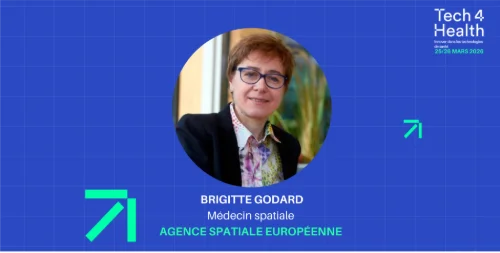
"Space medicine teaches us the excellence of prevention."
A physician specialized in space medicine, Brigitte Godard is a member of the Scientific Committee for Tech 4 Health 2026. She shares her vision of a connected and secure healthcare ecosystem, inspired by the stringent requirements of space medicine. Between prevention, technological innovation, and patient autonomy, she explains how space exploration can transform our terrestrial healthcare systems.
YOU AGREED TO JOIN THE TECH4HEALTH 2026 SCIENTIFIC COMMITTEE. WHAT MOTIVATED YOU TO PARTICIPATE IN THIS COLLECTIVE ENDEAVOR?
Joining the committee represents an opportunity to place prevention at the heart of technological innovation in healthcare. I am convinced that the future of care lies in our ability to anticipate risks rather than suffer them, a vision that Tech4Health also shares. It is also an opportunity to compare our approaches with those of the best experts in the field to bring forth concrete, innovative, and sustainable solutions.
Beyond the scientific aspect, I want to advocate for a medicine that uses technology not as an end in itself, but as a lever to put humans and health education back at the center of our practices. My objective is to bring a field perspective to transform today's care pathway into tomorrow's true health journey.
THE CENTRAL THEME OF THIS EDITION IS “CONNECT AND SECURE FOR BETTER CARE.” WHAT DOES THIS THEME MEAN TO YOU IN YOUR FIELD OF EXPERTISE?
"Connect" means breaking patient isolation by creating a continuous and benevolent link with healthcare professionals, wherever they may be. "Secure" is, of course, about protecting sensitive data, but it is primarily about securing the life journey by detecting weak signals before illness. This theme reminds us that technology is not an end in itself, but an indispensable lever of trust for preventive, predictive, and personalized medicine.
It is the alliance of digital robustness and clinical safety. This is everything I aim to bring with PrevenirCare.
WHAT CAN SPACE MEDICINE APPROACHES AND PROTOCOLS BRING TO BETTER SECURE HEALTH PRACTICES ON EARTH?
Space medicine is the art of keeping individuals healthy in an isolated and hostile environment, which is the ultimate model of prevention. It teaches us to educate astronauts about their health and thus develop rigorous remote monitoring protocols and autonomous diagnostic tools usable by everyone. These technologies, designed for zero gravity, are perfectly transposable to combat medical deserts or monitor chronic diseases.
In short, space forces us to achieve excellence in terms of autonomy, robustness, and reliability of remote care.
HOW DO EXTREME ENVIRONMENTS LIKE SPACE SHED LIGHT ON THE CHALLENGES OF CONTINUITY, RELIABILITY, AND SECURITY IN HEALTHCARE SYSTEMS?
In space, technical failure or interruption of care is not an option, because while return to Earth is currently possible from the ISS (International Space Station), it will be impossible for future interplanetary missions. Although technically possible within a day, it takes 3 days to ensure astronauts are recovered in the right place. This means they must have a minimum level of skill and autonomy. This "zero defect" requirement pushes us to design much more resilient and interoperable terrestrial healthcare systems.
This highlights the need for equipment capable of operating flawlessly and without connection, with personalized protocols to ensure continuity of care under all circumstances. It is this extreme rigor that must inspire the reliability of our care systems, trust among all stakeholders and medical/paramedical professions, as well as health education for the general public.