
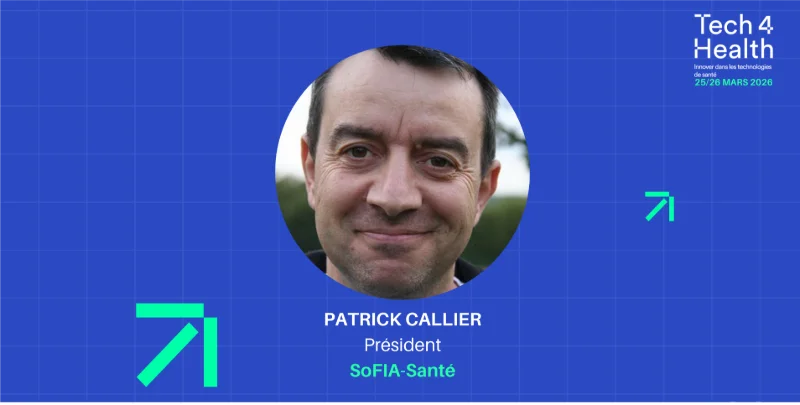
1. WHY IS SOFIA-SANTE INVOLVED IN TECH 4 HEALTH 2026?
Sofia-Sante is involved in Tech 4 Health 2026 to carry the voice of health artificial intelligence that is useful, ethical, and aligned with clinical realities. Our presence aims to strengthen exchanges between digital, health, data, and regulatory players to foster a positive and structured transformation of the healthcare system.
2. WHAT IS SOFIA-SANTE'S MISSION AND WHAT ROLE DO YOU WISH TO PLAY IN THE FRENCH HEALTH AI ECOSYSTEM?
Sofia-Sante was created to address the scarcity of scholarly structures dedicated to artificial intelligence applied to health and to support professionals facing the challenges posed by this technological revolution by structuring a French-speaking, ethical, and scientific approach to health AI. We aim to unite a multidisciplinary community — doctors, engineers, researchers, lawyers, and experts — and play a reference role by promoting training, the exchange of practices, and the development of rigorous best practices.
3. HOW DO YOU CURRENTLY ASSESS THE MATURITY OF FRENCH INSTITUTIONS REGARDING AI (TECHNICAL, REGULATORY, ETHICAL, ORGANIZATIONAL)?
The maturity of French institutions regarding AI is uneven. On a technical level, infrastructures are progressing, but data quality and interoperability remain major challenges. On a regulatory and ethical level, the framework is evolving with new European requirements, but its operational implementation in institutions is still ongoing. Organizationally, many institutions have not yet formalized cross-functional governance that integrates AI in a coherent manner.
4. WHAT KEY MESSAGES DO YOU WANT TO CONVEY TO FACILITY MANAGERS, CISOS, DPOS, AND HEALTHCARE PROFESSIONALS AT THE TRADE SHOW?
The first message is that AI should not be perceived as an end in itself, but as a lever to improve practices, quality of care, and organizational efficiency. Its success relies on clear governance, secure data integration, and shared ethical steering. The involvement of field professionals is essential to guarantee relevant and sustainable uses.
5. HOW DO YOU THINK THE ROLE OF THE CISO SHOULD EVOLVE IN THE FACE OF INCREASING USE OF GENERATIVE AND PREDICTIVE AI?
The CISO's role must evolve from a controller role to a digital trust strategist role. With the rise of generative and predictive AI, it is crucial to anticipate risks related to sensitive data, master cloud environments, and support the responsible adoption of tools, while guaranteeing security and compliance.
6. WHAT ARE THE MOST CONCERNING BIASES IN HEALTH AI TODAY AND HOW CAN THEY BE LIMITED IN PRACTICE?
The most concerning biases are those related to data representativeness, the heterogeneity of local clinical practices, and training on non-diversified historical databases. To limit them, it is necessary to conduct multicenter validations, involve clinicians in model evaluation, ensure methodological transparency, and implement regular audits of algorithms.
7. HOW CAN AI TRULY REDUCE THE ADMINISTRATIVE OR COGNITIVE LOAD OF HEALTHCARE TEAMS?
AI can lighten the administrative load by automating repetitive tasks such as writing reports or extracting relevant information from patient records. It can also reduce the cognitive load by synthesizing complex information and helping to prioritize decisions, allowing caregivers to focus more on direct care.
8. CONVERSELY, WHICH AI USES SEEM INSUFFICIENTLY ROBUST FOR CLINICAL APPLICATION TODAY?
Uses that are insufficiently robust are those that have not been validated in real-world conditions, particularly generative tools lacking human supervision or sufficient explainability, as well as certain predictive systems where the risk of error or bias is not sufficiently quantified.
9. WHAT IS THE MAIN DIFFICULTY FACED BY INSTITUTIONS IN MAKING THEIR HEALTH DATA RELIABLE?
The main difficulty lies in the heterogeneity of information systems and the variability of data entry practices, which compromise the quality and reliability of data. Without a robust data strategy, AI integration remains fragile.
10. HOW TO CREATE A SHARED CULTURE BETWEEN TECHNICAL, BUSINESS, AND CLINICAL PROFILES AROUND AI?
Creating a shared culture relies on continuous training initiatives, collaborative projects involving all stakeholders, and governance that encourages dialogue between technical experts, caregivers, and decision-makers. Promoting regular exchanges and common spaces for reflection is essential for building a shared vision.
11. HOW DOES SOFIA-SANTE SUPPORT INSTITUTIONS IN THIS ACCULTURATION?
Sofia-Sante supports institutions through continuous training, raising awareness of ethical and regulatory issues, and organizing scientific and collaborative exchange moments. It promotes the emergence of best practices and enables stakeholders to accelerate their skill development in AI in a structured and responsible manner.
12. HOW DO YOU IMAGINE THE ROLE OF AI IN THE FRENCH HEALTHCARE SYSTEM IN 5 YEARS?
In five years, AI will be an integral part of daily health tools, supporting clinical decisions, improving organizational efficiency, and automating certain administrative tasks. To be fully beneficial, it must be framed by ethical governance, clinically evaluated, and transparently integrated into care pathways, while being accompanied by appropriate training for all stakeholders.