
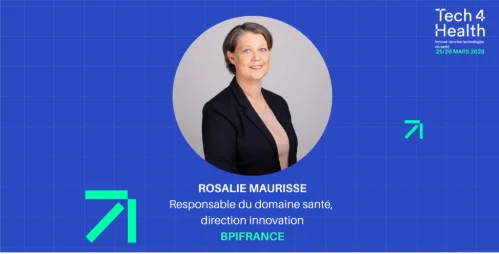
1. WHY IS BPIFRANCE A PARTNER OF TECH 4 HEALTH AND HOW DOES THIS FIT INTO YOUR STRATEGY?
Bpifrance is involved in Tech 4 Health because the event is an innovation accelerator, connecting industrial players, researchers, healthcare professionals, and entrepreneurs – a dynamic at the heart of French Care. This commitment is fully in line with our strategy to support health innovation, driven by France 2030, which allocates €7.5 billion to the health sector to support R&D, industrialization, and the market launch of health technologies.
2. WHAT MESSAGE WOULD YOU LIKE TO SEND TO PROJECT LEADERS AND EXECUTIVES?
Your role is essential for transforming our healthcare system. Continue to strive for excellence, accelerate your clinical validations, and structure your industrial models. Bpifrance and French Care are by your side to offer a continuum of financing and an environment conducive to bringing innovative solutions to market, notably through the i-Lab, i-Démo, and first factory competitions, as well as measures related to health acceleration strategies.
3. IS AGING A CONSTRAINT OR A LEVER FOR HEALTHTECH?
The aging population is creating new needs in prevention, telehealth, autonomy, and healthcare organization. The silver economy is thus becoming a strategic market, driven by innovations addressing home care, connected health, and aging well, in a context where nearly a third of French people will be over 60 by 2050.
4. WHAT VOLUMES OF FINANCING DOES BPIFRANCE DEDICATE TO HEALTHTECH AND WHAT TRENDS ARE BEING OBSERVED?
In 2024, Bpifrance injected €1.25 billion into the healthtech sector, including €682 million in innovation aid. Health represents 20% of the France 2030 financing managed by the public bank, making it one of the three main investment areas. The most dynamic projects involve biotechs, medical devices, and digital health, supported through national calls for projects and measures dedicated to deeptech.
5. WHAT WILL BE BPIFRANCE'S STRATEGIC PRIORITIES IN HEALTH OVER THE NEXT THREE YEARS?
Our priorities will focus on:
• Strengthening health sovereignty, through industrialization, biotechnologies, and the production of medical devices.
• Digital health, particularly AI, cybersecurity, interoperability, and predictive models.
• Prevention, with support for projects demonstrating their real-world value.